Social Icons

Friday, February 15, 2008

Aspartame - Is it Really that Bad?


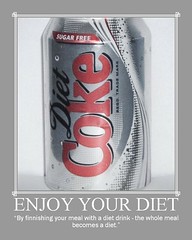
Diet or Regular?

I have been researching the effects of Aspartame for a couple weeks now and there is so much conflicting information that it's hard to come up with a definitive answer. So I thought I would provide some of the info that I found and let you form your own opinion on the discrepancy that aspartame is either harmful or helpful.

What is Aspartame?
Aspartame is a sugar substitute that is marketed under a number of trademark names, including Tropicana Slim, Equal, NutraSweet, and Canderel, and is an ingredient of approximately 6,000 consumer foods and beverages sold worldwide. It is commonly used in diet soft drinks, and is often provided as a table condiment. It is also used in some brands of chewable vitamin supplements and common in many sugar-free chewing gums. (http://en.wikipedia.org/wiki/Aspartame)

Those that support the use of Aspartame report the following:
  • It was approved safe by the FDA in 1981
  • Sugar substitutes do not cause cavities
  • It helps you lose weight since one teaspoon of sugar contains 16 calories, whereas aspartame has less than 1 calorie per teaspoon
  • To help control blood sugar, sugar substitutes reduce the total carbohydrate in meals and snacks and therefore can be a help in managing blood sugar levels.
  • A study was performed where subjects were given doses of aspartame, some being 20 times the daily amount taken by the vast majority of the general population. The results were that these subjects showed no changes in mood, memory, behavior, electroencephalograms (which record the electrical signals of the brain) or physiology that could be tied to aspartame.

Those opposed to the use of apartame argue the following:

  • It has been shown that aspartame in the dose accepted as safe by the FDA (50 mg/kg/day) can produce phenylalanine levels in a large number of women and their babies during pregnancy-large enough to produce abnormal development of the baby's brain.
  • The manifestations of aspartame disease in young children include severe headache, convulsions, unexplained vision loss, rashes, asthma, gastrointestinal problems, obesity, marked weight loss, hypoglycemia, diabetes, addiction (probably largely due to the methyl alcohol), hyperthyroidism, and a host of neuropsychiatric features.
  • It causes weight gain as a result from the liver working overtime to break down the chemicals in aspartame. Thus there is less energy available for fat burning and metabolism.
  • It causes unstable blood sugar levels, which increases the appetite and causes cravings for sweets/sugar.

In my opinion...
I beleive that aspartame hasn't been around long enough for us to know the long term effects. However, I also think that "everything in moderation" is a good rule to stick too. If you have any advice or additional info on this subject, leave me your comments!

Friday, January 25, 2008


Tips for Beginning Runners


Are you thinking about hitting the pavement ( or treadmill in this weather) and don't know where to begin? I've got a plan for you that may help to get you going or ease any frustrations.

Plan your runs on the basis time of rather than distance. Plan to get out of the house for a certain amount of time. Forget how far you go. Forget how fast you go. Just get out the door and stay out. For many people, thirty minutes of activity is a good place to begin. That does not mean running for thirty minutes. It means staying on your feet moving forward for thirty minutes. If you can run, run. If you can walk, walk. Do whatever you can, but keep moving forward. If it gets too hard, slow down.

A program of alternating running and walking is a good way to begin. The first week that may mean running for 5 minutes and walking for 5 minutes to recover. In time, it may mean running 10 minutes and walking 2, or running 15 and walking 1. You can work your way up to running the whole time and then you can start running for distance.

A great way of tracking your progress is by keeping a running log. I like to train for 5k's and 10k's so I keep track of my time, distance, running route, and how I felt on my run. You can use any notebook or if you'de like to track it online, Runner's World offers a free one that even graphs your progress. Click here to try it out.

Also, I found a Beginners Training Program at the "Run the Planet" website if you want any additional ideas. Good luck with your running aspirations!!!

Tuesday, January 22, 2008

How Well Do You Know Your Feet?


Asics Gel-Nimbus 9
Runner's World
Crowned it the
World's Best Shoe 2007


I've become well acquainted with my feet after spending years running on them. I've come to know what they need in order to give me the most comfort and best performance. Let me help introduce you to your feet.

When buying a new pair of running shoes, here's some guidelines I've found that should help:

Step 1 - Find a good running shoe store. You can buy your shoe at the local mega-mart, but the sales professionals in a specialty store are better trained to help you pick the right shoe. To locate a store, ask friends who run, check running magazine reviews, or check the yellow pages.
(I've used both Al's Sporting Goods and Sport's Authority and have been happy).

Step 2 - Examine the soles of your old running shoes. Notice the spots where the shoes show wear from the road. This tells you where your foot falls every time it hits the ground.

Step 3 - Place your shoes side-by-side on a flat surface. If the shoes tilt in toward the middle(pronation), your new shoe probably needs more stability than your old shoe. If they tilt to the outside (underpronation or supination), you may have a high arch and your new shoes should have good shock absorption (cushion).

Step 4 - Look at the top of your shoe. If you can see an outline of your big or little toe, and you've noticed discomfort in those areas while running, you should try a larger or wider shoe.
Step 5 - Consider the amount of running you will be doing. This tells you whether you should buy an elite running shoe or a basic model. The more intense the running, the more money you'll want to spend on the shoes.

Step 6 - Go to the running shoe store. Tell them what you've found out about your old shoes, or bring a pair with you. The employees should be able to "read" your old shoes and guide your choice. If not, you probably should find a different store.

Step 7 - Try out the shoes. Take a jog around the store. Try on as many shoes as it takes. Make sure you like the feel and fit of the shoe.

Step 8 - Buy the best running shoes for your feet. When you find the right pair, don't let them get away. Take them home and start breaking them in! (Wear them around the house for a few days before you go running to avoid blisters)


Personally I need a shoe with a wide width and cushion since I tend to underpronate. Also, I've come to like a shoe with some mesh lining that allows for my feet to breath. The best thing you can do is take an old shoe with you to the shoe store and most of the time they can analyze it and tell you what would work best for you.